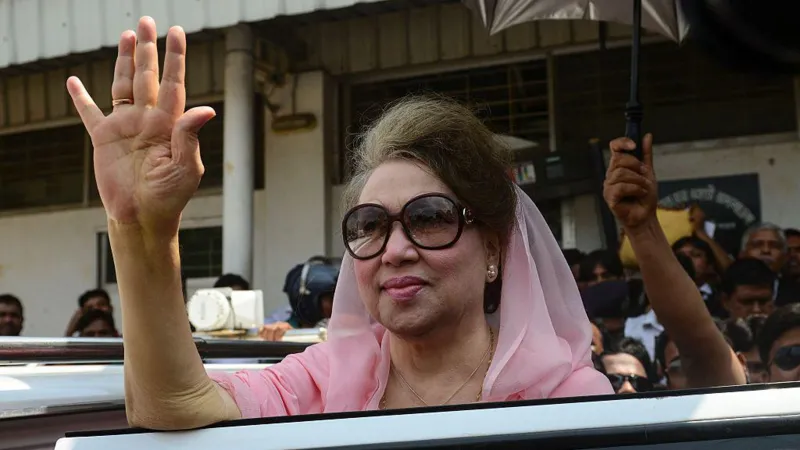
The Khaleda Zia death Bangladesh mourns today marks the end of a defining political era. Indeed, the former prime minister and opposition icon passed away at age 80 after a prolonged illness. On Tuesday morning, her party, the Bangladesh Nationalist Party (BNP), announced her death on Facebook. “Our favourite leader is no longer with us. She left us at 6am this morning,” the statement read.
Before she died, Zia spent over a month in the hospital battling kidney damage, heart disease, and pneumonia. Just days earlier, doctors described her condition as “extremely critical.” Although they placed her on life support, they said her age and frail health made aggressive treatment impossible.
Originally, Khaleda Zia entered politics after assassins killed her husband, President Ziaur Rahman, in 1981. At first, she appeared as a reserved widow. However, she quickly grew into a formidable political force. In 1991, she made history as Bangladesh’s first female prime minister—shattering deep-rooted barriers in a male-dominated system.
Her entire career centered on a bitter rivalry with Sheikh Hasina. For decades, the two women alternated in power and often accused each other of corruption and authoritarianism. Zia served three terms: 1991, a brief period in 1996, and again from 2001 to 2006.
Notably, people praised her first government for advancing women’s education and restoring parliamentary democracy. Yet, critics slammed her later terms. In 1996, she held a one-sided election without a neutral caretaker government. During her final term, authorities leveled corruption allegations against her—though she always denied wrongdoing.
After Hasina’s Awami League took power in 2009, Zia became the face of resistance. She firmly boycotted the 2014 elections after Hasina abolished the caretaker system. Later, courts convicted her on corruption charges and sent her to prison. Her supporters, however, insisted officials used the cases to silence her.
Everything changed in late 2024. Following massive anti-government protests, demonstrators toppled Hasina’s regime and forced her into exile in India. As a result, authorities released Zia from house arrest in January 2025. Just last week, her son, Tarique Rahman, returned from 17 years in London. At the time, the BNP confirmed she would run in the upcoming February elections.
When news of her death spread, crowds gathered outside Evercare Hospital in Dhaka. Her family, including Rahman, his wife, and daughter, stood by her in her final moments. Immediately afterward, the BNP asked the public to pray for her soul.
In response, interim leader Muhammad Yunus praised Zia as a “symbol of the democratic movement.” He added that she was “a source of utmost inspiration” and said her fight for multi-party democracy would never fade.
Even more remarkably, her longtime rival Sheikh Hasina paid tribute. From exile in India, Hasina posted on X that Zia’s “contributions to the nation were significant” and called her death a “profound loss for Bangladesh’s political life.”
Internationally, leaders also expressed condolences. Indian Prime Minister Narendra Modi said he was “deeply saddened” and honored her role in strengthening Bangladesh-India relations. Similarly, Pakistan’s Shehbaz Sharif called her “a committed friend of Pakistan.”
Ultimately, Khaleda Zia leaves behind a complex legacy. On one hand, she broke gender barriers and championed democracy. On the other, critics cite authoritarian tactics during her rule. Nevertheless, millions revered her as the moral voice of Bangladesh’s opposition. Now, with elections approaching, her death creates a void her son may soon try to fill.